
Pressure Problems
Boiler Pressure Problems: Why It Keeps Dropping (Or Won't Stop Rising)
Written & reviewed by our Gas Safe registered engineers · Last updated 22 July 2026
Pressure is the most misunderstood number on a boiler. These guides cover what your gauge is telling you, the difference between a gradual drop and a sudden one, how to repressurise safely yourself, and roughly what it costs to fix the underlying cause properly — rather than topping up a hidden leak for months.
Gas Safe 918817 North London specialists Upfront pricing
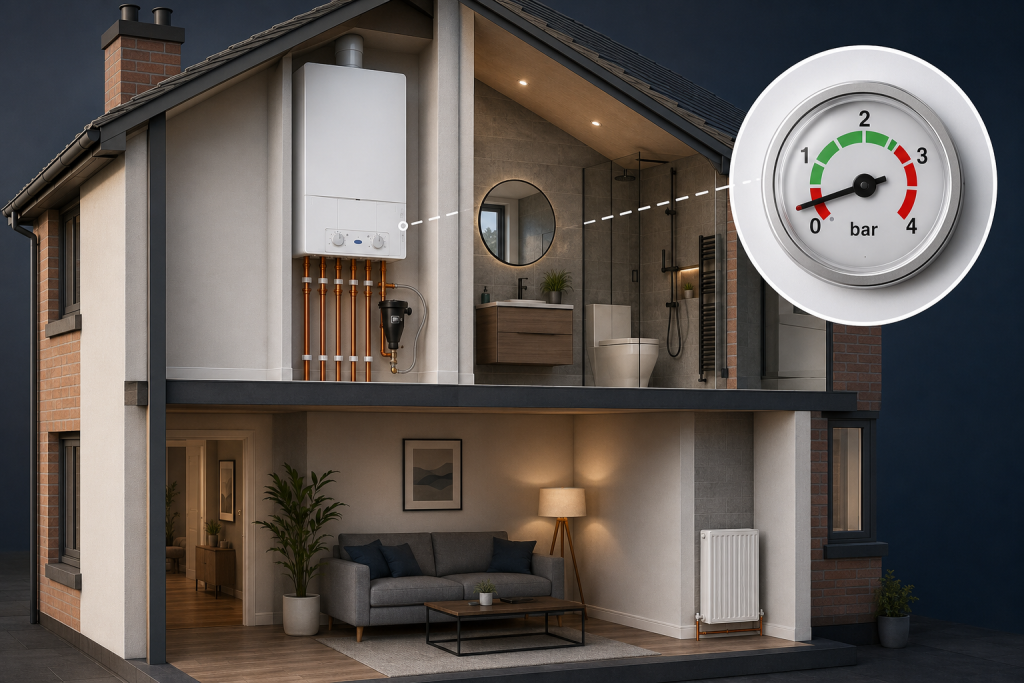
Quick answer: 1–1.5 bar cold is normal for most systems. Pressure that drops gradually over weeks points to a small leak somewhere in the system. Pressure that drops quickly and repeatedly usually means a specific fault — most often a failed expansion vessel or a leaking pressure relief valve.
Reading The Gauge
Reading your pressure gauge correctly
| Gauge reading (cold) | What it means | What to do |
|---|---|---|
| Below 1 bar | Low — boiler will likely lock out or refuse to fire | Safe to top up via the filling loop if it's a one-off |
| 1–1.5 bar | Normal healthy operating range | No action needed |
| Above 2.5–3 bar | High — risk of the pressure relief valve discharging | Don't keep bleeding to bring it down; get the cause checked |
Common Causes
What's actually causing the drop
- A pinhole leak in pipework, often hidden under floors and only visible as a damp patch or slowly dropping pressure.
- A weeping radiator valve joint — check around every valve for a faint white or green tide mark.
- A faulty pressure relief valve letting water escape externally, usually via a pipe through an outside wall.
- A failed expansion vessel that's lost its air charge, causing pressure to spike when the heating runs.
- A leaking filling loop that hasn't been fully closed off after last being used.
Step By Step
Repressurising your system safely
- Make sure the boiler is off and has cooled down before you start.
- Locate the filling loop — usually a flexible braided hose with a valve at each end, fitted under or near the boiler.
- Attach it if it’s detachable, or open both valves if it’s a fixed loop.
- Slowly open the valves and listen for water flowing in while watching the pressure gauge.
- Close the valves as soon as the gauge reaches around 1.3 bar — it’s easy to overshoot, so go slowly.
- Detach the flexible loop if applicable and turn the boiler back on.
- Check the pressure again after an hour. If it’s dropped noticeably, that points to a leak rather than a one-off top-up.
Costs
What it typically costs to fix
Typical North London ranges for guidance only — every job gets a fixed price after a proper look, not a quote over the phone.
FAQs
Pressure problems — your questions answered
Why does my pressure only drop when the heating is on, not when it's off?
This points to a leak that only shows itself under the higher pressure and temperature of an active system, or a faulty pressure relief valve opening slightly during heating cycles.
Is it safe to keep topping up the pressure myself if it keeps dropping?
Occasionally, yes — but repeatedly topping up a system that keeps losing pressure means water is going somewhere, and doing it for months can hide a leak that gets worse. Get it looked at if you’re topping up more than once every couple of months.
Why did my pressure suddenly jump up rather than down?
A sudden rise usually means the filling loop wasn’t fully closed after last use, or a failed expansion vessel that’s no longer absorbing the normal expansion of heated water.
Can cold weather affect my boiler pressure?
Yes — water contracts slightly as it cools, so pressure often reads a touch lower on very cold mornings. A drop of 0.1–0.2 bar with temperature is normal.
How often is it normal to need to top up pressure?
A well-sealed system shouldn’t need topping up more than once or twice a year at most. More frequent than that suggests a leak somewhere, even a very small one.
What's the difference between the expansion vessel and the pressure relief valve?
The expansion vessel absorbs the natural expansion of water as it heats, keeping pressure steady. The pressure relief valve is a safety device that releases water externally if pressure gets dangerously high. A failing expansion vessel is often what causes the relief valve to open.
Is a leaking filling loop dangerous?
Not dangerous in itself, but it will slowly over-pressurise the system if left unnoticed, and it wastes water. Worth checking it’s fully disconnected or closed after every use.
Why does my pressure gauge needle sit in the red even after topping up?
If it drops straight back to red within minutes or hours of topping up, that’s a strong sign of an active leak rather than a one-off low reading — worth booking an engineer rather than continuing to top up.
Can low pressure damage my boiler if I ignore it?
Most boilers simply lock out and refuse to fire below a certain pressure as a protective measure, so the immediate risk is losing heating and hot water rather than damage. But the underlying cause can worsen if left unaddressed.
Does the type of boiler I have affect how often I'll need to repressurise?
Sealed combi and system boilers need occasional manual repressurising via a filling loop, whereas older gravity-fed systems with a loft header tank usually top themselves up automatically. If you have a sealed system and top up unusually often, that’s a stronger signal of a leak.
Will a smart pressure sensor or app-connected boiler help me catch problems earlier?
Some newer smart thermostats and connected boilers can alert you to a pressure drop before it causes a lockout, which is genuinely useful for catching a slow leak early. It’s not a substitute for diagnosing the cause, but an early alert means you’re likely to book while it’s still a simple fix.
Related
Related pressure guides
Why it keeps dropping and how to find the leak.
Read guidePressureBoiler Low PressureWhat low pressure means and quick fixes.
Read guidePressureHow To Repressurise A BoilerThe full step-by-step, done safely.
Read guidePressureBoiler Pressure Too HighBringing it down without damage.
Read guideLeaksLeaksTracing where the water is going.
Read guidesBoiler ProblemsBoiler ProblemsWider boiler symptoms explained.
Read guidesIf topping up hasn’t held, book a boiler repair so we can find the actual leak. We attend pressure faults across Camden, Hornsey and Hackney, plus the rest of our coverage area.
Pressure keeps dropping and you can't find why?
We’ll trace the leak or fault properly rather than just topping you up again. Gas Safe registered, North London, upfront pricing.
Gas Safe Registered 918817 | North London specialists | Upfront pricing