Pressure Problems
Low Boiler Pressure? What It Means and How To Fix It
Reviewed by our Gas Safe registered engineers · Last updated 21 July 2026
If the gauge reads below about 1 bar, the boiler may lock out and refuse to fire. It’s usually easy to fix by topping up — but if it keeps happening, something is letting water out. Here’s what to do.
Gas Safe 918817 North London specialists Upfront pricing
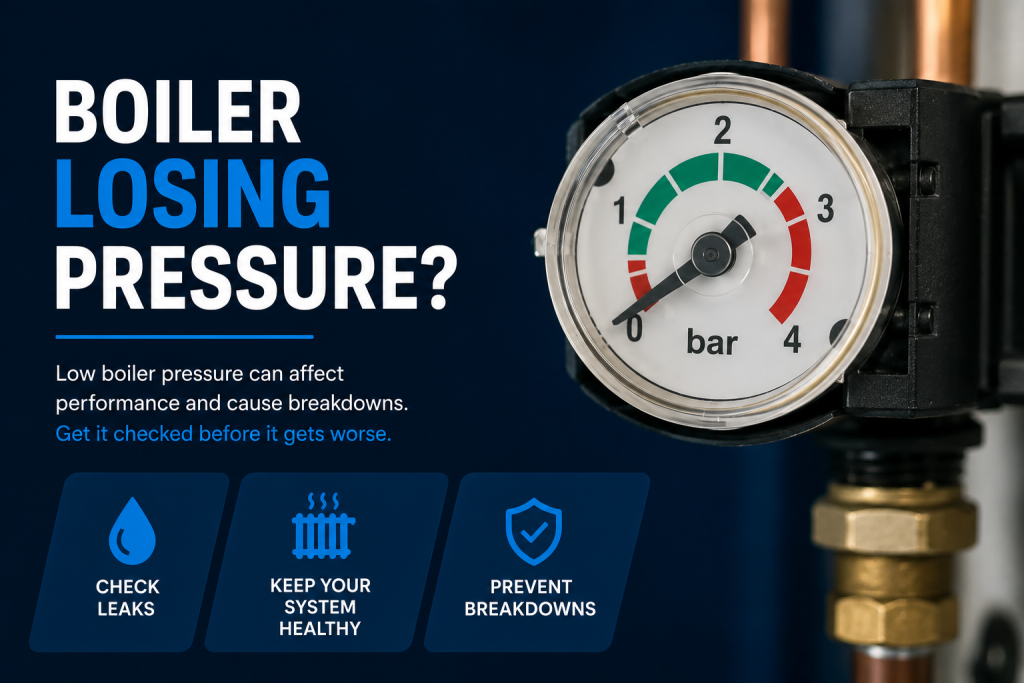
Quick answer: Healthy cold pressure is about 1–1.5 bar. If yours reads below 1, top it up to ~1.3 bar using the filling loop — the braided silver hose under the boiler. If it drops again soon after, a leak or faulty expansion vessel is the likely cause and needs an engineer.
Common Causes
Why boiler pressure reads low
These are the usual causes. The colour on the left shows whether it’s a safe homeowner check or a job for an engineer.
| What you see | Likely cause | What to do |
|---|---|---|
| Gauge reads below 1 bar | Pressure has dropped | Repressurise to ~1.3 bar via the filling loop |
| Boiler locks out on low pressure | Low-pressure cut-off | Top up, then reset the boiler |
| Keeps dropping after topping up | A leak somewhere | Book an engineer to trace it |
| Low just after bleeding radiators | Normal air loss | Repressurise to ~1.3 bar |
| Gauge sitting in the red zone | Very low pressure | Top up before running the heating |
| Won’t hold pressure at all | Expansion vessel or PRV fault | Needs an engineer to check |
Safe Checks
What you can safely do
Safe to do
- Top the pressure up to ~1.3 bar with the filling loop
- Check the gauge is genuinely low, not just a stuck needle
- Look for damp patches at radiator valves and pipe joints
- Reset the boiler once pressure is back to normal
Book an engineer if…
- You’re topping up more than once a month
- There’s a visible leak, or water at the overflow pipe
- The gauge won’t rise or won’t hold after topping up
Engineer Insight
What we usually find
A one-off top-up after bleeding radiators is completely normal. But if the gauge keeps sinking, water is escaping — usually a weeping radiator valve, a joint, or a tired expansion vessel. We trace the source and fix it, so you’re not topping up every week and risking a lockout when you least want one.
Costs
What repairs typically cost
Typical North London guide prices — you’ll always get an upfront quote before any work starts.
FAQs
Low pressure — your questions answered
What should my boiler pressure be?
Around 1–1.5 bar when the heating is off (cold), rising a little when it’s running. About 1.3 bar cold is the sweet spot for most boilers.
How do I fix low boiler pressure?
Top it up using the filling loop — the braided silver hose beneath the boiler. Open both valves slowly until the gauge reaches ~1.3 bar, then close them. Our repressurising guide has the full steps.
Why does my boiler lock out when pressure is low?
It’s a safety feature. Too little water means the boiler can’t circulate heat safely, so it shuts down. Restoring pressure and resetting usually gets it going again.
Is low boiler pressure dangerous?
The low pressure itself isn’t dangerous — the boiler protects itself by locking out. But a leak causing it can damage the property, so persistent low pressure is worth investigating.
Why does the pressure keep dropping?
Because water is escaping — a small leak at a valve or joint, or a failing expansion vessel or pressure-relief valve. If topping up doesn’t last, book an engineer to trace it.
Related
Keep troubleshooting
The step-by-step for topping up to 1.3 bar with the filling loop.
Read guidePressureBoiler Losing PressureIf topping up doesn’t hold — finding the leak.
Read guidePressureBoiler Pressure Too HighThe opposite problem and how to bring it down.
Read guideBoiler ProblemsBoiler Flashing a Warning LightLow pressure is a common trigger for a warning light.
Read guideBoiler ProblemsBoiler Not Turning OnLow pressure often stops a boiler firing at all.
Read guideFault CodesBoiler Fault Code LibraryLook up a low-pressure fault code by brand.
Browse codesBrowse all Pressure Problems guides, or head back to the Help & Advice Centre.
Pressure too low to fire? We’ll get you going.
Book a Gas Safe engineer if topping up doesn’t hold, or call and we’ll talk you through restoring pressure safely first.
Gas Safe Registered 918817 | North London specialists | Upfront pricing