Central Heating
How Central Heating Systems Work
Reviewed by our Gas Safe registered engineers · Last updated 22 July 2026
Knowing how the parts of your heating fit together makes every fault easier to understand — and every quote easier to trust. Here’s a plain-English tour of what happens between the boiler firing and your radiators warming up.
Gas Safe 918817 North London specialists Upfront pricing
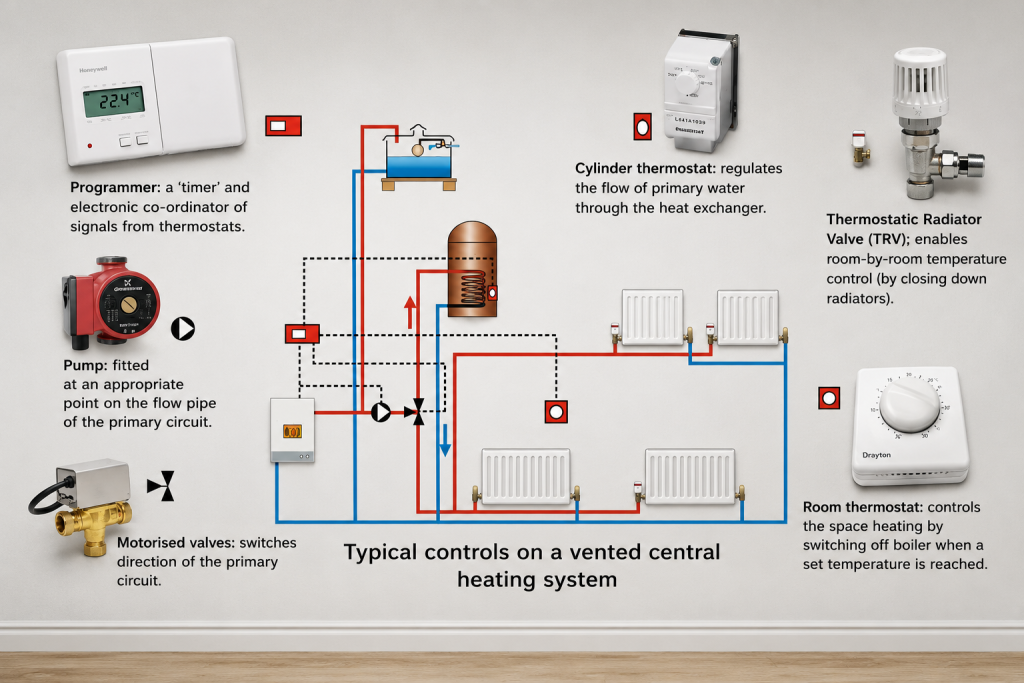
Quick answer: Your boiler heats water and a pump pushes it around a loop of pipes through your radiators, which give off heat and send the cooled water back to be reheated. A thermostat tells the boiler when to fire, the programmer sets the times, and an expansion vessel absorbs the pressure changes as the water heats and cools. In a combi, the same boiler also heats water on demand for your taps.
The Parts
What each part does
A central heating system is really just a loop with a few controls on it. Here’s what each part is doing while your home warms up.
| The part | What it does |
|---|---|
| Boiler | Burns gas to heat the water that circulates around your home |
| Circulating pump | Pushes the hot water around the pipework to the radiators |
| Radiators | Release heat into each room, then return cooler water to the boiler |
| Room thermostat | Tells the boiler to fire when the room drops below your set temperature |
| Programmer / timer | Sets when the heating and hot water come on |
| Thermostatic radiator valves (TRVs) | Let you set the temperature room by room |
| Expansion vessel | Absorbs the pressure change as water heats and expands |
| Filling loop | Tops the system back up to pressure when it drops |
| Diverter valve (combi) | Switches the flow between heating and hot water on demand |
System Types
Combi, system or heat-only?
Combi systems
One unit heats your radiators and your hot water on demand — no tanks or cylinder. Compact and efficient for smaller homes, though the hot-water flow drops if several taps run at once.
System & heat-only
These heat a stored cylinder of hot water, which suits homes with more than one bathroom. Heat-only (regular) systems also use a tank in the loft; system boilers keep more of the parts inside the unit.
Engineer Insight
It all comes back to the loop
The single most useful thing to know is the loop: hot water leaves the boiler, gives up its heat at the radiators, and comes back cooler to be reheated. Most heating faults are just that loop being interrupted — a stuck pump, air trapping the flow, a closed valve, or sludge slowing everything down. Once you picture the circuit, a cold radiator or a boiler short-cycling stops being a mystery and starts pointing at a specific part.
Costs
What heating work typically costs
Typical North London guide prices — you’ll always get an upfront quote before any work starts.
FAQs
Central heating — your questions answered
What are the main parts of a central heating system?
The boiler, a circulating pump, the radiators, a room thermostat and programmer, thermostatic radiator valves, and an expansion vessel. In a combi, a diverter valve also switches the boiler between heating and hot water.
What’s the difference between a combi and a system boiler?
A combi heats water on demand with no tanks or cylinder, ideal for smaller homes. A system boiler heats a stored cylinder of hot water, which copes better with several bathrooms running at once.
How does a thermostat control the heating?
It measures the room temperature and switches the boiler on when the room falls below your set point, then off once it’s reached — so the boiler only fires when heat is actually needed.
Why do I need an expansion vessel?
Water expands as it heats, and the expansion vessel gives that extra volume somewhere to go, keeping the pressure stable. When it fails you get pressure that climbs when hot and the relief valve weeping outside.
What is a powerflush and do I need one?
It’s a deep clean that removes sludge and rust from the system. You need it if radiators are cold at the bottom, the boiler is kettling, or the flow is sluggish — see our powerflush guide for the signs.
Related
Related guides
Keep the loop clean and flowing freely.
Read guideCentral HeatingCentral Heating Pump GuideThe pump that moves hot water round the loop.
Read guideHeatingThermostat ProblemsWhen the thermostat won’t call for heat.
Read guideRadiatorsRadiator Cold at the TopAir in the loop and how to clear it.
Read guidePressureBoiler Losing PressureHow pressure keeps the system working.
Read guideHeatingCentral Heating Not WorkingWhen the whole loop goes cold.
Read guideBrowse all Central Heating guides, or head back to the Help & Advice Centre.
Heating not behaving? We know the whole system.
Whether it’s a cold radiator or a full upgrade, book a Gas Safe engineer or call — we install, service and repair heating systems right across North London.
Gas Safe Registered 918817 | North London specialists | Upfront pricing