
Leaks
Pipe Leak Under the Sink? How to Find and Stop It
Reviewed by our Gas Safe registered engineers · Last updated 22 July 2026
Leaks in a sink cupboard usually come from one of a handful of places — a compression fitting, the trap, the waste, or an isolation valve. Most you can slow or stop yourself once you know which one it is. Here’s how to find it.
Gas Safe 918817 North London specialists Upfront pricing
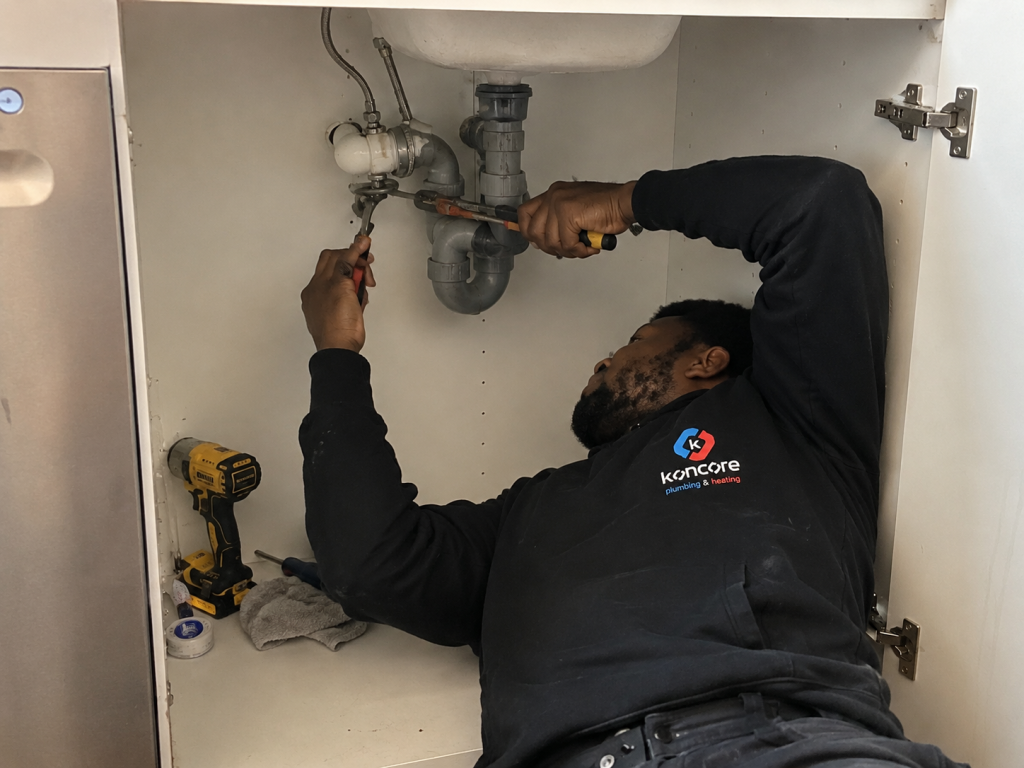
Quick answer: Dry everything in the cupboard, put down kitchen roll, and run the tap — then watch where the water appears. Water only when the tap runs points to a supply fitting or isolation valve; water only when you drain the sink points to the trap or waste. To stop a supply leak, turn the small isolation valve on that pipe a quarter-turn with a screwdriver (slot across the pipe means off), or turn off your stopcock.
Find the Source
Where under-sink leaks come from — and the fix
Dry the cupboard, then run the tap and drain the sink separately to see which one brings the water back. The colour on the left shows whether it’s a safe homeowner fix or a job for us.
| Where it leaks | Likely cause | What to do |
|---|---|---|
| Only when the tap is running | Loose compression nut on a supply pipe | Turn the isolation valve off, then tighten the nut a quarter-turn |
| From the U-bend when you drain the sink | Loose trap connector or perished seal | Hand-tighten the trap connectors; renew the washer if it still weeps |
| From a waste-pipe joint | Push-fit joint not pushed fully home | Push the connector fully home; an engineer can remake a solvent-welded joint |
| Dripping from an isolation valve | Worn valve O-ring | An engineer can replace the isolation valve |
| From the braided tap connector (flexi hose) | Split or corroded flexi hose | Turn the isolation valves off; an engineer will fit a new hose |
| Constant drip with the tap off | Mains-pressure supply leak | Turn off the stopcock and call us |
First Steps
What to do right now
Safe to do
- Clear the cupboard and dry everything so you can see the source
- Put down kitchen roll and run the tap to see where water appears
- Turn the isolation valve on that pipe a quarter-turn to shut it off (slot across the pipe = closed)
- Hand-tighten a loose trap or compression nut — snug, not forced
Stop and call us if…
- Water keeps coming with the tap off and the sink empty (mains-pressure leak)
- You can’t find or turn the isolation valve — use the stopcock instead
- The leak has reached a socket, extension lead, or the floor void
- It’s a solvent-welded or soldered joint that needs remaking
Engineer Insight
What we usually find
Most under-sink leaks we’re called to are either a compression nut that’s backed off or a cheap braided tap hose that’s split — both quick fixes. The one people miss is a slow trap leak that only shows when the sink drains, so the cupboard base swells over weeks before anyone notices. If your pipes have isolation valves (small valves with a screwdriver slot), you can shut off just that tap without turning the water off to the whole house.
Costs
What repairs typically cost
Typical North London guide prices — you’ll always get an upfront quote before any work starts.
FAQs
Under-sink leaks — your questions answered
How do I stop a leak under my sink quickly?
Find the small isolation valve on the leaking pipe and turn its slot a quarter-turn so it sits across the pipe — that shuts off just that tap. No isolation valve? Turn off your main stopcock (usually under the kitchen sink) instead.
Why is my sink only leaking when the tap is on?
That points to a supply-side fitting — a compression nut or the flexible tap connector — because those are only under pressure when water flows. A leak that appears when you drain the sink is the trap or waste instead.
Can I fix an under-sink leak myself?
Often yes. A loose compression nut or trap connector just needs hand-tightening, and a split flexi hose is a cheap swap once the isolation valves are off. Solvent-welded waste joints and mains-pressure leaks are best left to us.
What’s the difference between the trap and the waste leaking?
The trap is the U-bend that holds water to block drain smells; the waste is the pipe running to the wall. Trap leaks usually drip straight down when the sink empties; waste leaks show further along the horizontal pipe.
The cupboard floor is swollen — is that from the leak?
Almost certainly. Chipboard swells after weeks of a slow drip. Fix the leak, dry the cupboard fully, and replace the base board if it’s crumbling — a lingering smell means it’s still damp inside.
Related
Related guides
When a pipe leak has reached the ceiling below.
Read guideLeaksBoiler Leaking WaterIf the water is coming from the boiler instead.
Read guideLeaksRadiator Leaking WaterFor a leaking radiator rather than a pipe.
Read guideEmergencyBoiler Breakdown EmergencyOur 24/7 cover for leaks and breakdowns that won’t wait.
Read guidePressureBoiler Losing PressureHeating pipe leaks show up as dropping pressure.
Read guideMaintenanceSigns Your Boiler Needs ServicingKeep the whole system checked once a year.
Read guideBrowse all Leak guides, or head back to the Help & Advice Centre.
Leak under the sink you can’t reach? Call us.
Book a plumber to trace and fix the leak, or call — we cover North London and keep 24/7 slots for leaks that are spreading.
Gas Safe Registered 918817 | North London specialists | Upfront pricing