
Pressure Problems
How to Repressurise a Boiler: A Step-by-Step Guide
Reviewed by our Gas Safe registered engineers · Last updated 21 July 2026
Topping your boiler back up to the right pressure is a safe, two-minute job most people can do themselves. Here’s exactly how, using the filling loop — plus what to do if the gauge won’t cooperate.
Gas Safe 918817 North London specialists Upfront pricing
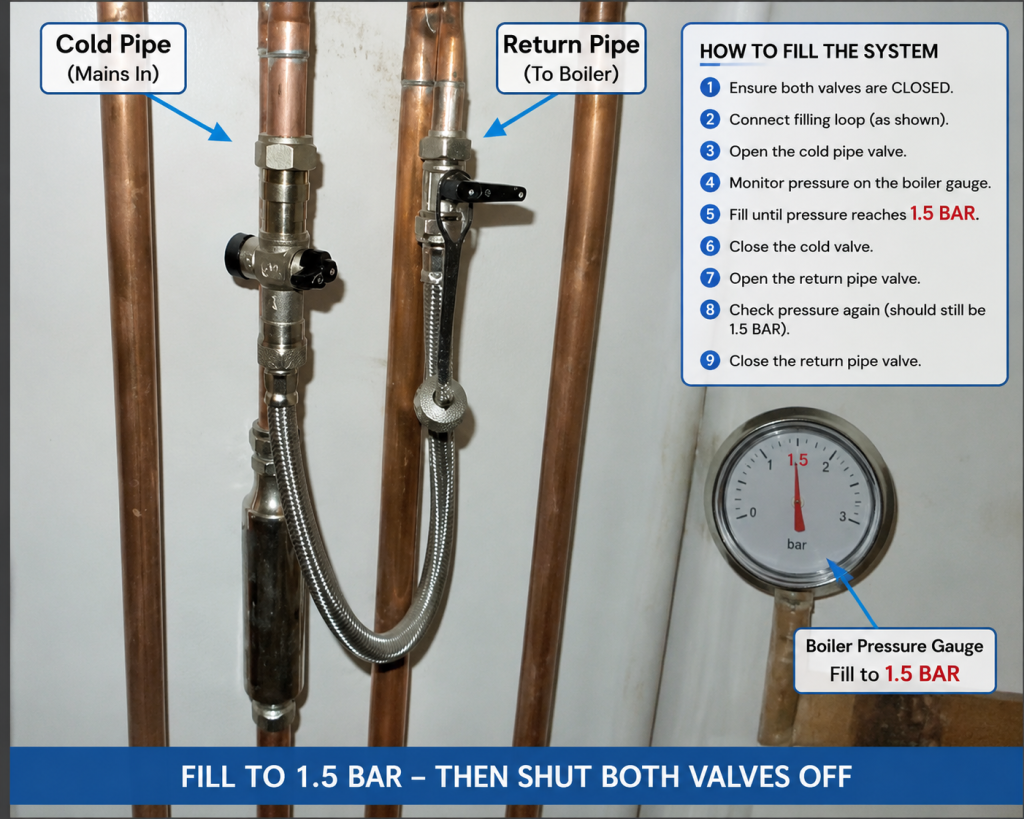
Quick answer: Turn the heating off, find the filling loop (a braided silver hose beneath the boiler), open both valves slowly until the gauge reads about 1.3 bar, close them firmly, then restart the boiler. If it was locked out on low pressure, reset it once pressure is back to normal.
Step by Step
How to repressurise your boiler
- 1. Turn the heating off and let the boiler cool for a few minutes
- 2. Find the filling loop — usually a braided silver hose with a valve at each end, under the boiler
- 3. Open both valves slowly; you’ll hear water flowing into the system
- 4. Watch the gauge rise to about 1.3 bar (don’t go past 1.5)
- 5. Close both valves firmly once you reach the right pressure
- 6. Restart the boiler, and reset it if it had locked out
Troubleshooting
If repressurising doesn’t go to plan
| What happens | Likely cause | What to do |
|---|---|---|
| Gauge won’t rise | Valves not fully open | Open both valves slowly and fully |
| Pressure rises then drops again | A leak in the system | Book an engineer to trace the leak |
| Overfilled past 2 bar | Too much water added | Bleed a radiator to release some pressure |
| No filling loop visible | It may be internal or keyed | Check the manual; some boilers need a key |
| Gauge stays at zero | Faulty gauge or sensor | An engineer can test and replace it |
Good to Know
A few safety pointers
Do
- Aim for about 1.3 bar cold — comfortably in the green zone
- Open the valves slowly so pressure rises gently
- Close both valves fully afterwards to stop it creeping up
Don’t
- Don’t force a stiff valve or use tools on it
- Don’t overfill past 1.5–2 bar — bleed a radiator if you do
- Don’t keep topping up if it won’t hold — that means a leak
Engineer Insight
From our engineers
Repressurising is genuinely simple and safe to do yourself — the only thing to watch is not overfilling. If you find you’re doing it more than a couple of times a year, don’t just keep topping up: that’s a leak or a failing expansion vessel, and it’s worth getting traced before it causes damage.
Costs
If you’d rather we did it
Typical North London guide prices — you’ll always get an upfront quote before any work starts.
FAQs
Repressurising — your questions answered
What is a filling loop?
It’s the braided silver hose beneath the boiler, with a valve at each end, that connects the mains water to your heating system. Opening it lets water in to raise the pressure.
What pressure should I fill to?
About 1.3 bar when the boiler is cold — comfortably in the green zone on the gauge. It’s normal for it to rise a little when the heating is running.
What if I can’t find the filling loop?
Some boilers have an internal or keyed filling system rather than a visible braided hose. Check your boiler’s manual — or call us and we’ll talk you through your specific model.
I’ve overfilled — what now?
If the gauge is above about 2 bar, bleed a radiator to release some water until it settles back to around 1.3 bar. Make sure both filling-loop valves are fully closed.
How often should I need to do this?
Only occasionally — maybe once or twice a year after bleeding radiators. If you’re repressurising every few weeks, book an engineer to find the leak.
Related
Related guides
Why the reading drops low and what it means.
Read guidePressureBoiler Losing PressureWhen topping up doesn’t hold — finding the leak.
Read guidePressureBoiler Pressure Too HighIf you’ve overfilled or the reading climbs.
Read guideBoiler ProblemsBoiler Not Turning OnLow pressure is a common reason a boiler won’t fire.
Read guideHeatingHeating Not WorkingThe full troubleshooting guide if there’s still no heat.
Read guideFault CodesBoiler Fault Code LibraryLook up a low-pressure fault code by brand.
Browse codesBrowse all Pressure Problems guides, or head back to the Help & Advice Centre.
Rather we did it? Book a quick visit.
If the pressure won’t hold or you’d prefer a professional to check it, book a Gas Safe engineer — or call and we’ll talk you through it on the phone.
Gas Safe Registered 918817 | North London specialists | Upfront pricing