
Radiators
Radiator Not Getting Hot? Causes and Fixes
Reviewed by our Gas Safe registered engineers · Last updated 22 July 2026
One stone-cold radiator while the rest are warm is usually a stuck valve, a seized TRV pin, trapped air, or sludge. Here’s how to tell which — and the fix for each.
Gas Safe 918817 North London specialists Upfront pricing
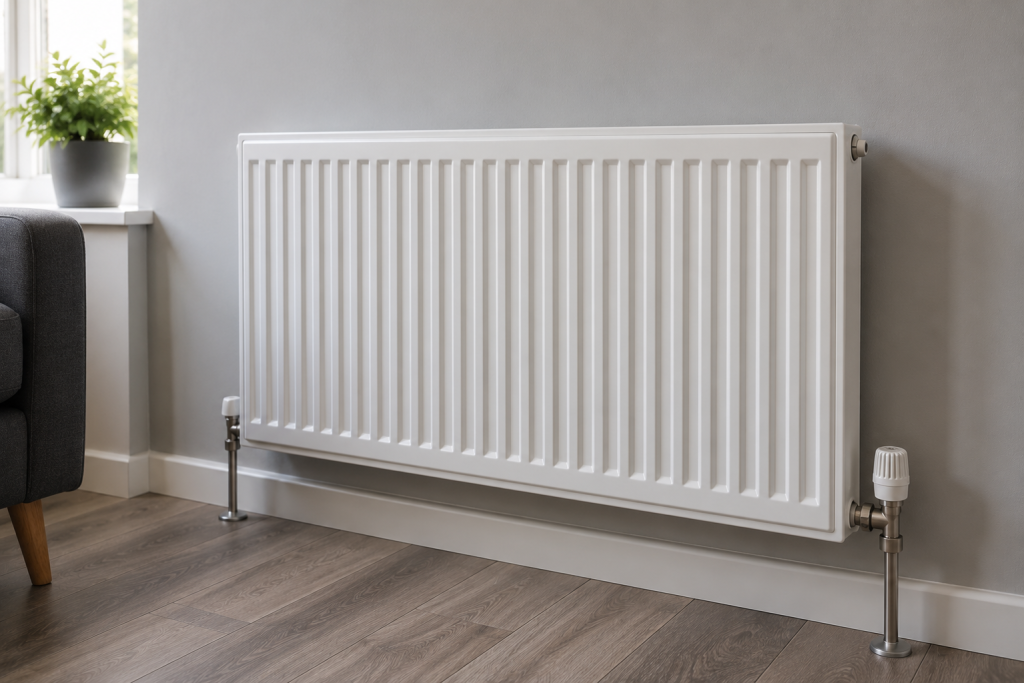
Quick answer: If just one radiator won’t heat, check both its valves are open and the TRV pin isn’t stuck down. Cold at the top means air (bleed it); cold at the bottom means sludge (flush it). If every radiator is cold while the boiler runs, it’s a system issue — see our Radiators Cold But Boiler Working guide.
Common Causes
Why a radiator won’t get hot
Work through these for a single cold radiator. The colour on the left shows whether it’s a safe homeowner check or a job for an engineer.
| What you see | Likely cause | What to do |
|---|---|---|
| One radiator completely cold | Stuck TRV pin or closed valve | Free the TRV pin; check both valves are open |
| Cold at the top only | Trapped air | Bleed the radiator |
| Cold at the bottom only | Sludge | A powerflush clears it; book an engineer |
| Cold after decorating or removal | Valve left closed or an airlock | Open both valves; bleed the radiator |
| Lukewarm, never fully hot | Needs balancing or partial sludge | Balance the system; flush if it persists |
| Every radiator cold | Pump, valve or thermostat | See Radiators Cold But Boiler Working |
Safe Checks
What you can safely do
Safe to do
- Check both radiator valves are fully open
- Free a stuck TRV pin: take the head off and tap/gently free the pin
- Bleed the radiator if it’s cold at the top
- Feel where it’s cold — top (air) versus bottom (sludge)
Book an engineer if…
- It’s cold at the bottom (sludge needs flushing)
- The valve or TRV is seized and won’t free up
- Every radiator is cold while the boiler is running
Engineer Insight
What we usually find
For a single cold radiator, a seized TRV pin is the most common cause we find — the little pin under the thermostatic head sticks down and stops flow. Popping the head off and gently freeing it usually does the trick. After that it’s air (bleed), sludge (flush) or balancing. If the whole system’s cold, it’s the pump or a valve, not the radiators.
Costs
What repairs typically cost
Typical North London guide prices — you’ll always get an upfront quote before any work starts.
FAQs
Radiator not heating — your questions answered
Why is only one radiator not getting hot?
Usually a stuck TRV pin or a closed valve, sometimes trapped air or sludge in that radiator. Check the valves are open and free the TRV pin first — that solves most single cold radiators.
How do I free a stuck TRV pin?
Unscrew and lift off the thermostatic head. You’ll see a small pin — gently tap it or move it up and down with pliers until it springs freely. Refit the head and the radiator should heat.
Should both radiator valves be open?
Yes — the TRV (or wheel valve) at one end and the lockshield at the other both need to be open for water to flow. A valve closed after decorating is a common cause of a cold radiator.
Why are all my radiators cold but the boiler is on?
That’s a system fault rather than one radiator — usually the pump, a motorised valve, or the thermostat not calling for heat. Our Radiators Cold But Boiler Working guide covers it.
Could my radiator be the wrong size?
If it heats but never warms the room, it may be undersized for the space, or partly sludged. An engineer can advise on balancing, flushing or a larger radiator.
Related
Keep troubleshooting
Trapped air — the bleed fix.
Read guideRadiatorsRadiator Cold at the BottomSludge — when a flush is needed.
Read guideRadiatorsHow to Bleed a RadiatorStep-by-step to release trapped air.
Read guideHeatingRadiators Cold But Boiler WorkingWhen every radiator stays cold.
Read guideCentral HeatingPowerflush GuideClearing sludge that stops radiators heating.
Read guideHeatingHeating On But House Still ColdWhen radiators are warm but rooms aren’t.
Read guideBrowse all Radiator guides, or head back to the Help & Advice Centre.
One cold radiator? We’ll warm it up.
Book a Gas Safe engineer to free the valve, bleed, flush or balance the system — or call and tell us which radiator’s cold and where.
Gas Safe Registered 918817 | North London specialists | Upfront pricing