
Radiators
Radiator Cold at the Bottom? Causes and Fixes
Reviewed by our Gas Safe registered engineers · Last updated 22 July 2026
Warm at the top but cold along the bottom is the tell-tale sign of sludge — not air. Bleeding won’t fix it; the radiator needs flushing. Here’s what’s happening and how we put it right.
Gas Safe 918817 North London specialists Upfront pricing
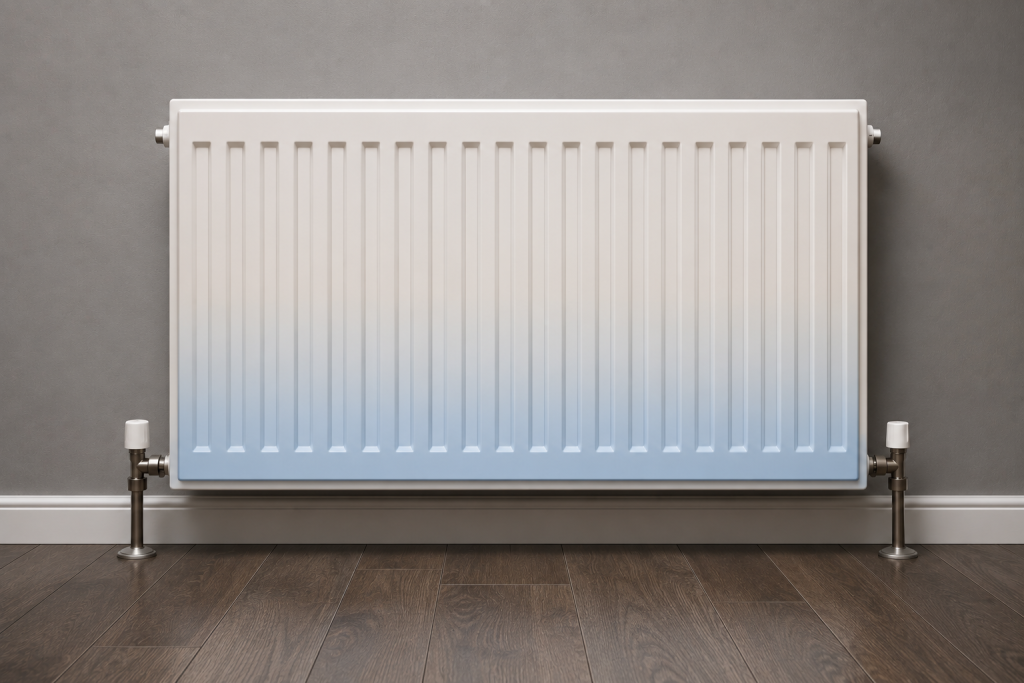
Quick answer: Cold along the bottom while the top stays warm means sludge (magnetite) has settled inside the radiator and is blocking the flow. Bleeding does nothing for this — the fix is a powerflush (or a single-radiator flush), followed by an inhibitor to stop it coming back.
Common Causes
Why a radiator is cold at the bottom
Nearly all of these come down to sludge. The colour on the left shows whether it’s a safe homeowner check or a job for an engineer.
| What you feel | Likely cause | What to do |
|---|---|---|
| Cold at the bottom, warm at the top | Sludge settling in the radiator | A powerflush usually clears it; book an engineer |
| Cold patches across the bottom | Heavy sludge build-up | Book a powerflush and an inhibitor top-up |
| Just one radiator cold at the bottom | Localised sludge | A single-radiator flush can help; an engineer can advise |
| Boiler kettles and rads cold at the bottom | The whole system is sludged | Powerflush plus inhibitor is recommended |
| Getting worse over the years | Corrosion with no inhibitor | An engineer can flush and add inhibitor |
| Cold at the bottom after a new radiator | Air or installation debris | Bleed and check; if it persists, flush the radiator |
Safe Checks
What you can safely check
Safe to check
- Feel the radiator: cold at the bottom points to sludge, cold at the top to air
- Bleed it once to rule out trapped air
- Note if the boiler kettles or several radiators are affected
- Check whether an inhibitor has ever been added (ask us if unsure)
Book an engineer if…
- Bleeding makes no difference (it’s sludge, not air)
- The bottom stays cold across one or more radiators
- The boiler kettles or the system is slow to warm up
Engineer Insight
What we usually find
Cold at the bottom is sludge nearly every time — magnetite from internal corrosion sinks and blocks the lower channels. A powerflush clears it and restores full output; on a badly sludged system we’ll fit a magnetic filter and add inhibitor so it doesn’t return. Systems that have never had inhibitor are the usual culprits in older North London homes.
Costs
What repairs typically cost
Typical North London guide prices — you’ll always get an upfront quote before any work starts.
FAQs
Cold at the bottom — your questions answered
Why is my radiator cold at the bottom?
Sludge — corrosion debris called magnetite — has settled in the bottom of the radiator and is blocking the flow, so hot water can’t reach the lower section. It needs flushing, not bleeding.
Will bleeding fix a radiator cold at the bottom?
No. Bleeding only releases trapped air, which sits at the top. Cold at the bottom is sludge, and a powerflush or radiator flush is what clears it.
What is a powerflush?
It’s a deep clean of the whole heating system using a pump and cleaning chemicals to push out sludge and rust, restoring flow and efficiency. We finish by adding inhibitor to protect it.
How do I stop sludge coming back?
Add a corrosion inhibitor after any flush, and fit a magnetic filter to catch debris before it settles. We check and top up inhibitor as part of an annual service.
Can I flush just one radiator?
Sometimes — a single sludged radiator can be removed and flushed out. But if several are affected or the boiler kettles, a full powerflush is the better fix.
Related
Keep troubleshooting
What a powerflush does and when sludge is the cause.
Read guideRadiatorsRadiator Cold at the TopThe air problem — and how bleeding fixes it.
Read guideRadiatorsRadiator Not Getting HotStuck valves, TRVs and balancing.
Read guideHeatingRadiators Cold But Boiler WorkingSludge, air and balancing across the system.
Read guideBoiler ProblemsBoiler Making NoiseKettling and sludge go hand in hand.
Read guideRadiatorsHow to Bleed a RadiatorRule out trapped air first with a quick bleed.
Read guideBrowse all Radiator guides, or head back to the Help & Advice Centre.
Cold at the bottom? A flush will fix it.
Book a Gas Safe engineer to flush the system and add inhibitor, or call and describe the symptoms — we’ll tell you whether a single-rad flush or full powerflush is right.
Gas Safe Registered 918817 | North London specialists | Upfront pricing