
Radiators
How to Bleed a Radiator: A Step-by-Step Guide
Reviewed by our Gas Safe registered engineers · Last updated 22 July 2026
Cold at the top but warm at the bottom? That’s trapped air, and bleeding the radiator is a safe five-minute job. Here’s exactly how to do it — and what to do if it doesn’t warm up afterwards.
Gas Safe 918817 North London specialists Upfront pricing
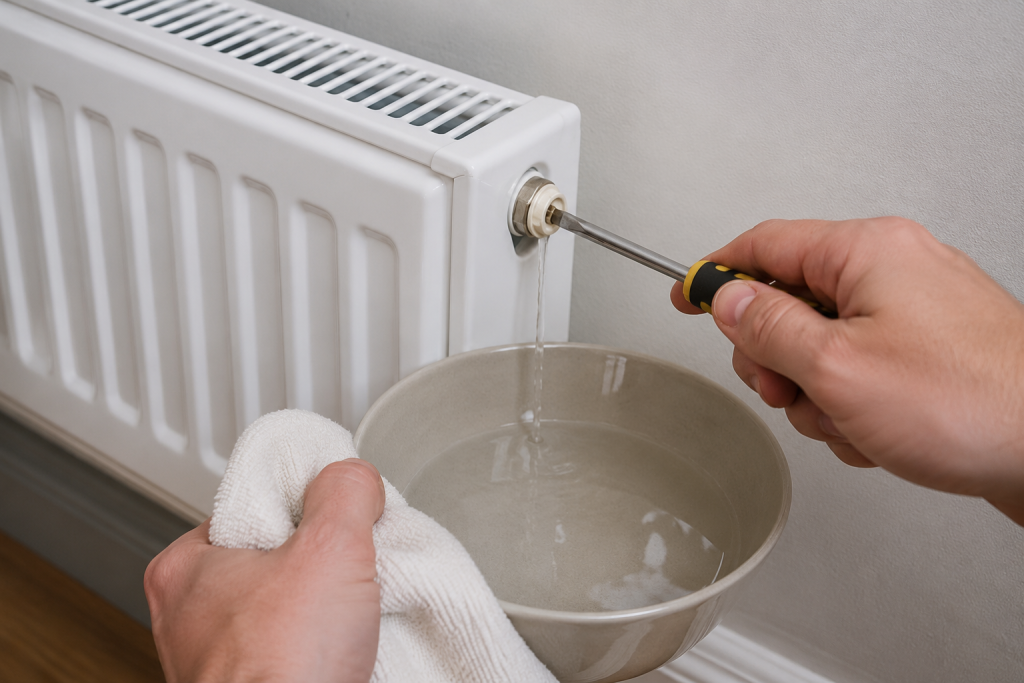
Quick answer: Turn the heating off and let the radiators cool. Hold a cloth under the bleed valve at the top corner, turn the radiator key anticlockwise a quarter-turn until the hiss of air becomes a trickle of water, then close it. Finally, top the boiler pressure back up to about 1.3 bar.
Step by Step
How to bleed a radiator
- 1. Turn the heating off and let the radiators cool so you don’t get scalded
- 2. Find the bleed valve — the small square peg at a top corner of the radiator
- 3. Hold a cloth or cup underneath to catch drips
- 4. Turn the key anticlockwise a quarter-turn — you’ll hear air hissing out
- 5. Close the valve as soon as water trickles out steadily
- 6. Check the boiler pressure and top up to ~1.3 bar if it dropped
Troubleshooting
If bleeding doesn’t sort it
| What happens | Likely cause | What to do |
|---|---|---|
| No air or water comes out | Valve seized or no trapped air | Check the valve isn’t stuck; try another radiator |
| Water sprays out fast | Valve opened too far | Close it and open only a quarter-turn next time |
| Still cold at the top | More air, or a system fault | Bleed again; if it recurs, check for a leak |
| Cold at the bottom, not the top | Sludge, not air | Bleeding won’t help — a powerflush may be needed |
| Pressure dropped after bleeding | Normal — water replaced the air | Repressurise the boiler to ~1.3 bar |
| Key won’t fit the valve | Wrong bleed key size | Check and get a standard clock/radiator key |
Good to Know
A few pointers
Do
- Bleed with the heating OFF and radiators cool
- Start with the radiator furthest from the boiler, working back
- Re-check and top up the boiler pressure afterwards
Don’t
- Don’t force a seized valve — you can snap it
- Don’t open the valve more than a quarter-turn
- Don’t keep bleeding the same rad repeatedly — that points to a leak
Engineer Insight
From our engineers
Bleeding is genuinely simple and safe. The one thing to watch: if a radiator needs bleeding again and again, air is getting in — usually a small leak or a corroding part — and that’s worth an engineer’s look. And remember, cold at the bottom is sludge, not air, so bleeding won’t touch it.
Costs
If you’d rather we did it
Typical North London guide prices — you’ll always get an upfront quote before any work starts.
FAQs
Bleeding radiators — your questions answered
How do I know if my radiator needs bleeding?
If it’s cold at the top but warm at the bottom, or you hear gurgling, there’s trapped air — bleeding will fix it. Cold at the bottom instead means sludge, which needs flushing.
Should the heating be on or off to bleed a radiator?
Off, with the radiators cool. Bleeding a hot, pressurised radiator risks scalding and makes a mess. Turn the heating off and give it time to cool first.
Why is my radiator still cold after bleeding?
Either there’s more air to release (bleed again), the valve is stuck, or the problem is sludge or balancing rather than air. If it stays cold, an engineer can diagnose it.
Do I need to top up the boiler pressure after bleeding?
Usually yes. Releasing air lowers the system pressure, so check the gauge and top up to about 1.3 bar with the filling loop if it’s dropped.
How often should I bleed my radiators?
Once a year, ideally at the start of the heating season, is plenty for most homes. If a radiator needs it far more often, there may be a leak drawing air in.
Related
Related guides
The classic trapped-air symptom bleeding fixes.
Read guideRadiatorsRadiator Cold at the BottomWhen it’s sludge, not air — and bleeding won’t help.
Read guideRadiatorsRadiator Not Getting HotStuck TRVs, closed valves and balancing.
Read guideHeatingRadiators Cold But Boiler WorkingWhen several radiators stay cold at once.
Read guidePressureHow to Repressurise a BoilerTopping the pressure back up after bleeding.
Read guideBoiler ProblemsBoiler Making NoiseGurgles and knocks are often trapped air too.
Read guideBrowse all Radiator guides, or head back to the Help & Advice Centre.
Radiator still cold? We’ll get it warm.
If bleeding doesn’t do it, book a Gas Safe engineer to balance, flush or check for a leak — or call and we’ll talk you through it first.
Gas Safe Registered 918817 | North London specialists | Upfront pricing