Landlord Certificates
EICR vs Gas Safety Certificate: What's The Difference?
Reviewed by our Gas Safe registered engineers · Last updated 22 July 2026
Landlords sometimes assume one certificate covers everything — but gas and electrical safety are checked separately, by different professionals, on different schedules. Confusing the two is a common way to end up unknowingly non-compliant on one while assuming the other covers it.
Gas Safe 918817 North London specialists Upfront pricing
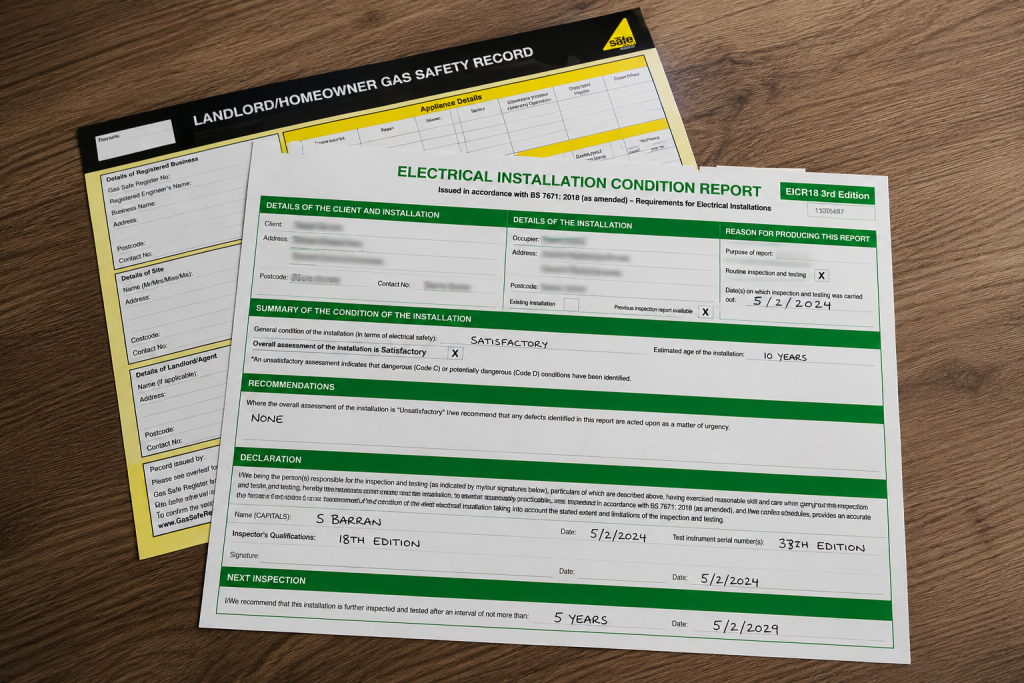
Quick answer: a Gas Safety Certificate covers gas appliances and pipework, renewed annually by a Gas Safe engineer. An EICR covers the property’s electrical installation, renewed every five years by a qualified electrician. If the property has gas, you need both.
Comparison
Side by side
| Gas Safety Certificate (CP12) | EICR | |
|---|---|---|
| Covers | Gas appliances, flues, pipework | Electrical installation, wiring, consumer unit |
| Renewal | Every 12 months | Every 5 years (or change of tenancy) |
| Carried out by | Gas Safe registered engineer | Qualified, registered electrician |
| Required if | Property has any gas appliance or supply | Always required for rented properties |
Engineer Advice
Why the confusion happens
Both certificates are legal requirements for rented properties, both involve a qualified professional inspecting something in the home, and both get referenced together in general landlord compliance checklists — which is exactly why they blur together in people’s minds. But they’re issued by entirely different trades, cover completely different systems, and run on different renewal cycles, so tracking them separately matters. All-electric properties with no gas supply only need the EICR; any property with a gas boiler, hob or fire needs both.
Costs
What each certificate typically costs
An EICR is a larger inspection covering the whole electrical installation, but only needs renewing every five years — so its annual cost works out considerably lower than the gas certificate over time.
Typical ranges rather than guaranteed prices — we can arrange your gas safety certificate directly, and point you toward a trusted local electrician for the EICR. You’ll always get an upfront quote before any work starts.
FAQs
EICR and gas safety — your questions answered
Does Koncore carry out EICR inspections as well as gas safety checks?
We focus on gas, heating and plumbing, so EICRs need a qualified electrician — we’re happy to point you toward one if needed, but we don’t carry those out ourselves.
Do I need to renew the EICR every time I get a new tenant?
Not automatically — an EICR is valid for 5 years regardless of tenancy changes, unless the previous report specifically flagged issues requiring earlier follow-up.
Is an EICR the same thing as PAT testing for appliances?
No — an EICR covers the property’s fixed electrical installation (wiring, sockets, consumer unit), while PAT testing covers portable appliances like kettles or lamps, and isn’t currently a strict legal requirement for most rentals in the same way.
What if my EICR and Gas Safety Certificate are due around the same time?
There’s no issue with them falling close together — they’re independent requirements, though some landlords find it convenient to batch related property admin around the same period each year.
Can a failed EICR affect whether I can legally let the property?
Yes. If an EICR identifies serious issues requiring remedial work, that work must be completed within the specified timeframe (usually 28 days) before continuing to let — similar in principle to a failed gas safety check.
Do smoke and carbon monoxide alarms fall under either certificate?
No — alarm requirements are a separate landlord obligation from both the EICR and Gas Safety Certificate. That said, a carbon monoxide alarm is required in any room with a gas appliance, so it’s worth checking during your gas safety visit.
Which certificate should I prioritise if I can only arrange one right now?
Whichever is closer to its deadline or already lapsed — both are equally mandatory. If both are due around the same time, the gas safety check is worth booking slightly sooner given its shorter, tighter annual renewal window compared to the EICR’s five-year cycle.
Do new-build rentals need both certificates from day one?
Yes — a new-build with a gas supply still needs an initial gas safety check before the first tenancy, and an EICR is still required. A new electrical installation may come with its own compliance certificate that can sometimes satisfy the initial EICR requirement — worth checking with the electrician who did the original work.
Related
Related guides
What a CP12 is and what it covers.
Read guideLandlord CertificatesLandlord Gas Safety DutiesThe full legal checklist beyond the check itself.
Read guideLandlord CertificatesHow Often Do You Need One?Timing, renewals and the anniversary date.
Read guideMaintenanceAnnual Boiler ServiceA service is not the same as a safety check.
Read guideMaintenanceSigns Your Boiler Needs ServicingSpotting problems between checks.
Read guideEmergencyCarbon Monoxide Warning SignsThe safety risk behind the checks.
Read guideBrowse all Landlord Certificate guides, or head back to the Help & Advice Centre.
Need your gas safety side sorted?
We handle the gas certificate and we’ll happily point you to the right electrician for the EICR. Gas Safe registered, North London, upfront pricing.
Gas Safe Registered 918817 | North London specialists | Upfront pricing