
Landlord Certificates
The Gas Safety Certificate (CP12): A Complete Guide
Reviewed by our Gas Safe registered engineers · Last updated 22 July 2026
If you let a property in England or Wales with any gas appliance, pipework or flue, you’re legally required to have it checked every year by a Gas Safe registered engineer and hold a valid Gas Safety Certificate — still commonly called a CP12 after the old form number.
Gas Safe 918817 North London specialists Upfront pricing
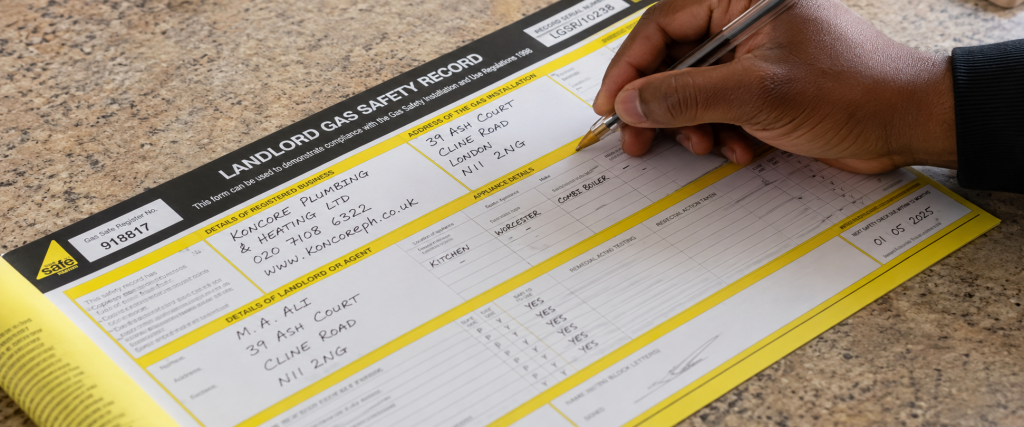
Quick answer: a Gas Safety Certificate confirms all gas appliances, flues and pipework in a rented property have been checked and are safe. It’s a legal requirement, valid for 12 months, and must be renewed annually by a Gas Safe registered engineer. It’s not the same as a boiler service.
Engineer Advice
What actually gets checked
A Gas Safety Certificate covers every gas appliance and the pipework and flues that serve it. Here’s what the engineer inspects and confirms on each visit.
| Area checked | What the engineer confirms |
|---|---|
| Every gas appliance — boiler, hob, oven, fire | Correct operation and safe gas pressure |
| All visible pipework | No leaks, correct fittings, adequate support |
| Flues and ventilation | Dangerous combustion products are safely removed from the property |
| Safety devices on each appliance | They shut the appliance off correctly if a fault occurs |
| Case seals and internal condition | Sound and sealed — particularly on the boiler |
Step by Step
What happens on the day
- The engineer confirms access to every gas appliance in the property, including any in outbuildings.
- Each appliance is inspected individually and checked for correct combustion, pressure and safe operation.
- Visible pipework and fittings are checked for leaks or damage.
- Flues and ventilation are tested to confirm safe removal of combustion gases.
- Any issues found are explained on the spot, along with the next steps if something needs remedying before a certificate can be issued.
- A digital certificate is generated and provided, typically within 24–48 hours.
Engineer Insight
What happens if something fails
If the engineer finds a problem, the appliance is classified as either ‘at risk’ or ‘immediately dangerous’ depending on severity. An immediately dangerous appliance is disconnected on the spot with your permission; an at-risk one can usually stay in use short-term while repairs are arranged. Either way you’ll be told clearly on the day, and the certificate is only issued once everything is confirmed safe — so a ‘fail’ is really just a to-do list, not a dead end.
Costs
What it costs
Typical North London guide prices — you’ll always get an upfront quote before any work starts.
FAQs
Gas Safety Certificates — your questions answered
Do owner-occupied properties need a Gas Safety Certificate too?
No — the legal requirement applies specifically to rented properties. Owner-occupiers are strongly encouraged to have annual gas safety checks for their own safety, but it isn’t a legal obligation in the same way.
What happens if an appliance fails the check?
It will be classified as either ‘at risk’ or ‘immediately dangerous’ depending on severity. Immediately dangerous appliances are disconnected on the spot with your permission; at-risk ones can usually continue in use short-term while repairs are arranged.
Can I be present during the check, or does the engineer need the property to themselves?
You’re welcome to be present, and it’s often useful for tenants to be there too so any access issues (like appliances in locked rooms) can be resolved on the spot.
Does the certificate cover appliances tenants bring themselves, like a gas cooker they’ve installed?
Tenant-owned appliances aren’t legally your responsibility to certify, though many landlords choose to have them checked anyway for safety and to avoid ambiguity — and we’re happy to include them in the visit.
Is a Gas Safety Certificate the same thing as a boiler service?
No, they’re different (though often done together for convenience) — a safety check confirms appliances are safe to use, while a service is more thorough maintenance aimed at efficiency and preventing breakdowns.
What if the property has no gas appliances at all?
If there’s genuinely no gas supply or appliances in the property, no certificate is required — though it’s worth keeping documentation confirming this in case it’s ever queried.
Do I need a new certificate if I change letting agent partway through the year?
No — the certificate belongs to the property and its validity period rather than to whichever agent is managing it, so a change of agent doesn’t trigger a renewal. It’s worth making sure your new agent has a copy on file, though, since they’ll need it for tenants and to demonstrate compliance if asked.
Can I get a certificate for a property I’m about to let for the first time?
Yes, and it’s a sensible step to arrange before marketing a property for let, since you’ll need a valid certificate in place before a new tenancy begins. Many landlords time this alongside other pre-letting checks, such as an EPC, to have everything ready together.
Related
Related guides
Timing, renewals and the anniversary date.
Read guideLandlord CertificatesLandlord Gas Safety DutiesThe full legal checklist beyond the check itself.
Read guideLandlord CertificatesEICR vs Gas Safety CertificateThe two checks landlords confuse.
Read guideMaintenanceAnnual Boiler ServiceA service is not the same as a safety check.
Read guideMaintenanceSigns Your Boiler Needs ServicingSpotting problems between checks.
Read guideEmergencyCarbon Monoxide Warning SignsThe safety risk behind the checks.
Read guideBrowse all Landlord Certificate guides, or head back to the Help & Advice Centre.
Due a Gas Safety Certificate?
Book with our Gas Safe registered engineers and get your certificate within 48 hours. Managing several properties? We’ll set up a renewal schedule and keep you compliant. Upfront pricing, North London.
Gas Safe Registered 918817 | North London specialists | Upfront pricing